

Frankenstein - A Tragedy of Creation
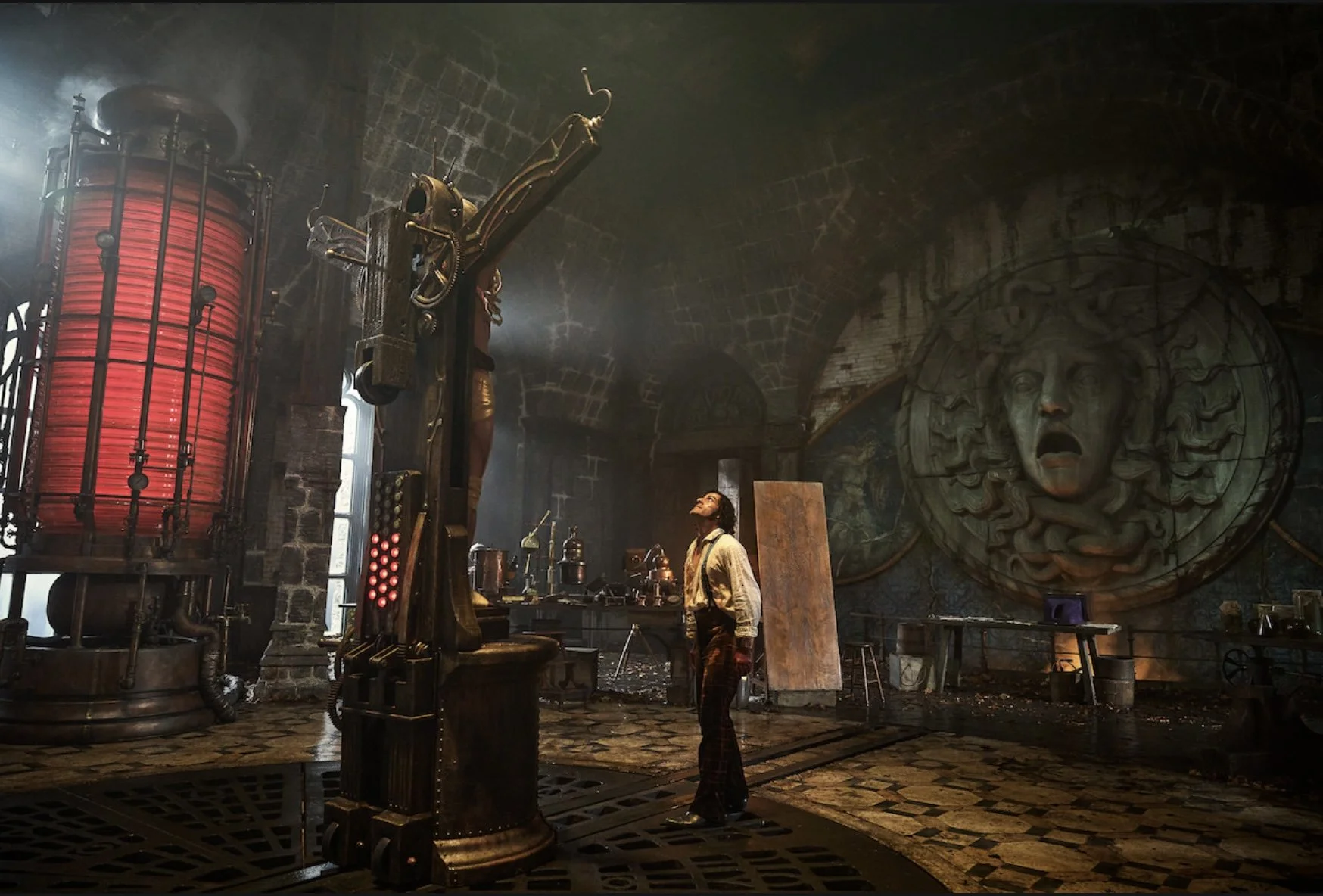
Photograph from the Netflix Gallery
Guillermo del Toro’s Frankenstein is a story of creation – of a life carelessly imposed upon the creature. Devoid of nurture and identity, it embraces the projection of the monster his own creator has reduced him to.
Much like a newborn being brought into this world assembled within its mother’s womb, we gain a unique glimpse into the construction of the soul from “birth” shaped through parallels between the perverse pair of father and son.
In stark contrast to previous Netflix original film productions, the adaptation has set a new precedent regarding the standard for the streaming platform.
For thirty years, del Toro has been planning to tell his version of Mary Shelley’s Frankenstein, and much like the scientist himself, the labour has paid off in the successful result it has produced.
Unlike Frankenstein’s diligence, however, the movie has thus far remained a success, nourished beyond its production and acclaimed as one of the most visually and narratively accomplished films of recent cinema.
Del Toro’s exploration of genius, when ego consumes humanity, is centred around the scientist Frankenstein (Oscar Isaac), who, after a tragic loss in his childhood, traps himself in an insanity approaching obsession with immortality.
But the story is not only his. What might a life look like that was created out of the limbs collected from the dead, pieced together by a man who did not think beyond the initial point of creation?
As life force brings the creation (Jacob Elordi) to life, the creator himself grapples with the disdain for his -in his humanity – fallible achievement. It is, therefore, not he who finds beauty in this curious creation.
It is the fiancée of Frankenstein’s brother, Elizabeth (Mia Goth), who becomes his desired lifeline, someone who sees beyond the monster others perceive him to be. Within her consideration for other life forms, she showcases a delicate understanding of his uncertainty of existence.
Between the two of them, simple gestures, like the gifting of a leaf, symbolise an intimacy that exceeds a simplistic take on lust. Rather, their connection forms a stark contrast to Frankenstein’s initial attitude towards the creature and plants the seed for future desires in the creature’s life within a world that he has no place in.
With visual parallels to infamous artworks, such as the creation of Adam by Michelangelo, the cinematic universe is laced with a miscellaneous assortment of meanings and interpretations.
Generally marked by a darker colour palette, the gothic ties of the story’s history shape the aesthetic tone of the film. The absence of randomness is what, furthermore, breathes life into the aesthetic creation.
Through the intentional use of red, for example, a thread is woven from Frankenstein’s mother, who is cloaked in the colour, to the lasting impression her death has on the course of his life. The colour reappears only in context to him as the film proceeds, either as part of his clothing or in relation to his by spiritual encounters guided scientific obsession.
Obsession, albeit a different kind, has made waves amongst viewers, particularly in regard to the relationship between Elizabeth and the creature. It is to no surprise that the breathtaking performances encompassing gentleness, yearning and tragedy of biblical extent, have captured their attention. Yet, it does lead one to wonder whether their connection rooted in a silent understanding of souls has been lost in the noise of the audience’s desire for their romantic love.
After all, while it is individual veils of isolation connecting the characters, it is also their individual otherness that keeps them apart from one another. None of the relationships are linear or can be encompassed into a single definition, and neither can their own paths.
The complexities of each of the character’s unique struggle to belong opens up a wider discussion not only of our human desire for greatness, a trait still as relevant as it was in 1818, but in a modern context it begs the question: have we evolved enough to understand both our own limitations, as well as the complexities of our humanity when faced with the unknown?
The dichotomy as captured in the creature also resides in our own human selves. In the words of Mary Shelley: “Thus strangely are our souls constructed, and by slight ligaments are we bound to prosperity and ruin.”